
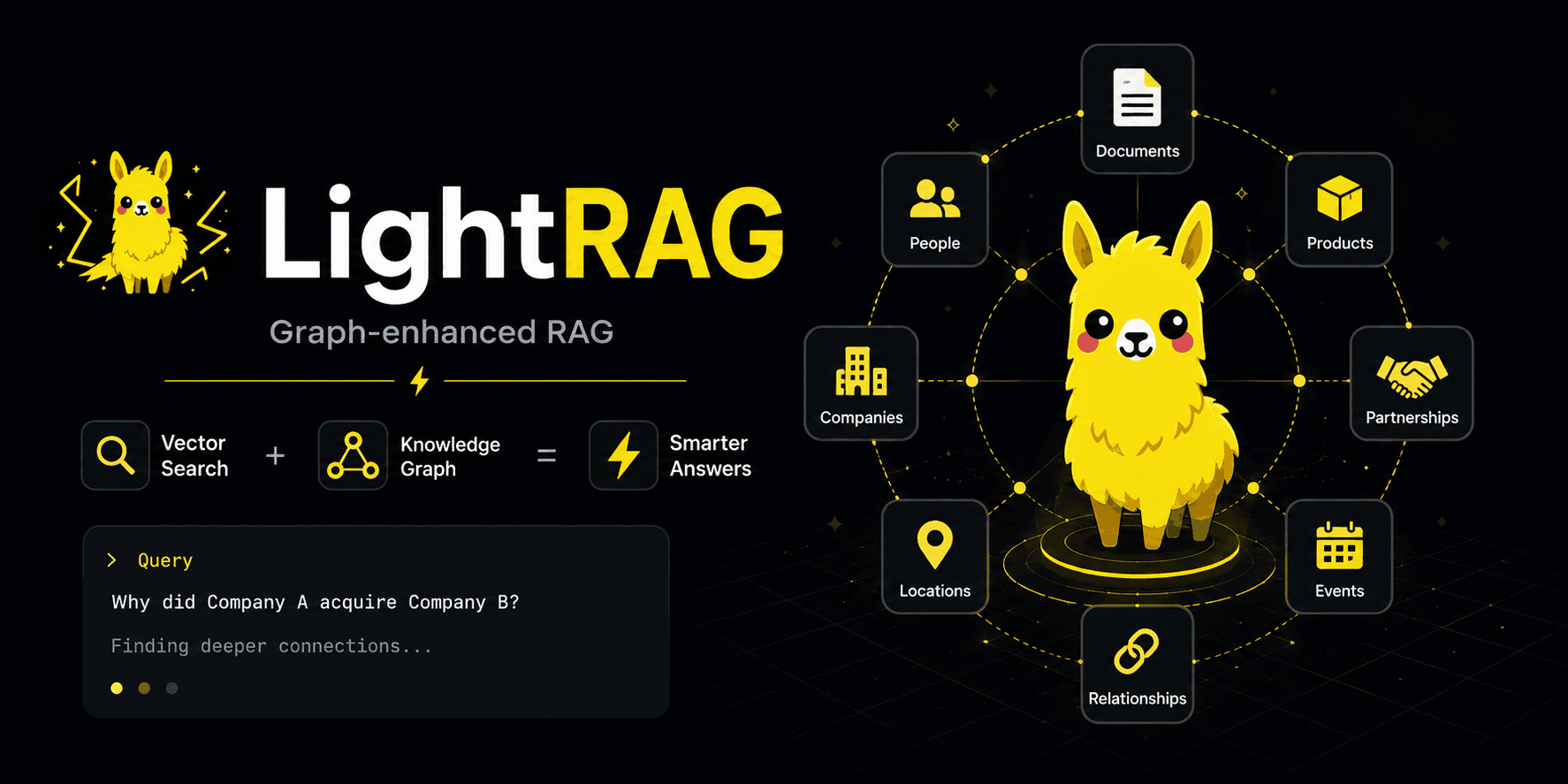
Most Retrieval-Augmented Generation (RAG) systems start with a surprisingly simple premise: split documents into bite-sized chunks, turn those individual chunks into mathematical embeddings, store them neatly in a vector database, and simply retrieve the most semantically similar chunks when someone inevitably asks a question. While that approach works remarkably well for basic factual queries, it is also inherently limited by its architecture.
Traditional RAG excels at finding text that visually or semantically mirrors the query. However, it is demonstrably weaker at understanding how disparate pieces of information are actually connected. If your underlying documents extensively discuss people, large companies, intricate legal roles, software products, critical decisions, or causal dependencies, the most important information frequently lives in the complex relationships between those entities, not merely within the isolated paragraphs. LightRAG presents an incredibly interesting solution because it explicitly attempts to fix that relational gap without recklessly abandoning the highly effective, normal RAG pipeline. It still diligently chunks documents, embeds text, and utilizes standard vector search. But crucially, it also proactively extracts entities and relationships, securely stores them in a highly traversable graph, and seamlessly utilizes that graph layer during the retrieval process.
In plain English, LightRAG does not just ask, "Which text chunks are mathematically similar to this specific question?" It simultaneously asks, "Which core concepts are heavily involved, how are they fundamentally connected to each other, and what vital nearby information should be intelligently pulled in because of those explicit connections?" That dual-layered approach is the core, defining idea behind LightRAG.
The Problem With Plain Chunk-Based RAG
A normal RAG pipeline usually looks something like this:
Document -> Chunk -> Embed -> Vector database -> Retrieve chunks -> LLM answerThe system rapidly splits a document into chunks, embeds each resulting chunk, and securely stores the embeddings. Later, at query time, it embeds the user's query and performs a nearest-neighbor search for chunks residing in a remarkably similar embedding space. While this is mathematically clean and computationally efficient, it is also incredibly flat.
The vector database essentially does not know that ACME Corp is a real company, that Jane Smith is its designated legal representative, that Gmail is a commercial product, or that one specific chunk formally defines a term while another seemingly unrelated chunk explains its long-term implications. The database only vaguely comprehends that certain pieces of text are mathematically close to one another in an n-dimensional space. This structural blindness can easily cause several severe issues in production.
First, highly relevant information may be inconveniently spread across multiple disconnected chunks. One chunk might mention a company name, another chunk might describe a specific leadership role, and a third chunk might finally explain the actual responsibility tied to that role. If none of those chunks alone happens to be an overwhelmingly obvious semantic match for the user's query, the basic retriever will likely miss one or all of them. Second, some user questions are inherently relational by their very nature. "Who definitively has signing authority?" is not merely asking for similar-sounding prose; it is explicitly demanding an understanding of specific entities, roles, and structural relationships. Third, broad, thematic questions often require heavy synthesis. Asking "How does corporate governance actively work across this document set?" requires much more than a single matching paragraph. It fundamentally demands themes, relationships, and highly diverse supporting evidence spread across the entire corpus.
LightRAG specifically adds a graph layer to meticulously address exactly these challenging, multi-hop cases.
What LightRAG Adds
LightRAG intentionally keeps the familiar, robust RAG foundation entirely intact, but it cleverly adds a parallel, secondary path during the indexing phase.
Document -> Chunk -> Embed chunks
                   -> Extract entities and relationships
                   -> Build graph
                   -> Embed entities and relationships
This dual process means a single document ultimately produces substantially more than just isolated chunk embeddings. It simultaneously produces rich, structured graph data. An entity in this system might be a key person, an overarching company, a specific product, a legal role, a government regulation, a broad concept, or a physical location. A corresponding relationship simply describes exactly how two specific entities are connected. For instance, Jane Smith may be explicitly defined as the legal representative of ACME Corp, or ACME Corp may fundamentally operate a specific cloud service.
Once those critical entities and complex relationships exist within the system, LightRAG can effectively retrieve information in vastly more intelligent ways than simple vector search allows. It can meticulously match entities. It can match specific relationships. It can seamlessly fetch highly relevant neighboring nodes directly from the graph. Crucially, it can also still retrieve normal text chunks exactly like traditional RAG. Ultimately, it intelligently combines all of those diverse sources into a significantly richer, more robust context window for the final language model to evaluate. This multi-pronged retrieval is precisely why LightRAG is frequently described as graph-enhanced RAG. The embedded graph absolutely does not replace traditional retrieval; instead, it grants the retrieval process vital, much-needed structure.
LightRAG Is Not Contextual Embedding
It is remarkably easy to accidentally confuse LightRAG with contextual embedding techniques, but they represent fundamentally different architectural strategies. In Anthropic's highly popular contextual retrieval approach, each individual chunk receives extra, carefully generated document-level context before it is actually embedded. A normal chunk like this:
The company's revenue grew by 3% over the previous quarter.Might dynamically become this heavily enriched version before embedding actually occurs:
This chunk is from an SEC filing on ACME Corp's performance in Q2 2023. The previous quarter's revenue was $314 million. The company's revenue grew by 3% over the previous quarter.The critical defining point here is that the added, descriptive context is permanently baked into the chunk embedding itself. The retriever is technically still searching strictly over text chunks, but those chunks have been dramatically enriched with external context beforehand.
LightRAG operates in a completely different manner. It absolutely does not forcefully prepend a custom summary to every single chunk prior to embedding. Instead, its context inherently comes from traversing the graph structure. Rather than saying, "Let me make this specific chunk significantly more self-contained before embedding it," LightRAG philosophically says, "Let me diligently extract the core concepts this chunk discusses, securely store their relationships, and strategically use those relationships much later when someone actually asks a complex question."
That fundamental distinction dictates everything about how the system scales. Contextual embedding permanently enriches the resulting vector, whereas LightRAG dramatically enriches the real-time retrieval process.
| Question | Contextual embedding | LightRAG |
|---|---|---|
| Where does context come from? | A generated chunk-specific summary | Extracted entities and relationships |
| When is context added? | Before chunk embedding | During indexing and query-time retrieval |
| How is context retrieved? | Through the chunk vector | Through graph search plus vector search |
The simplest way to effectively conceptualize the difference is this: LightRAG willingly trades embedded textual context for highly traversable structural context.
The Storage Model
LightRAG purposefully stores distinct kinds of information across surprisingly different storage systems. While that approach can certainly look annoyingly redundant at first glance, each distinct storage type actually has a highly specialized, non-overlapping job. There are currently four main storage categories within the architecture:
| Storage type | Purpose |
|---|---|
| Key-value storage | Stores raw text, metadata, descriptions, and cache entries |
| Vector storage | Stores embeddings for semantic search |
| Graph storage | Stores nodes, edges, and graph structure |
| Document status storage | Tracks document processing state |
The default, out-of-the-box setup can easily use extremely simple local storage, such as basic JSON files, NanoVectorDB, and NetworkX. However, robust production setups can flawlessly swap in enterprise-grade tools like PostgreSQL, Redis, MongoDB, Qdrant, Milvus, Faiss, Neo4j, Memgraph, or heavily modified PostgreSQL utilizing specialized graph and vector extensions. The most important thing to grasp is not the specific backend technology chosen, but rather the strict separation of architectural responsibilities. Key-value storage exists exclusively for direct, fast lookup. Vector storage exists solely for nuanced similarity search. Graph storage is meticulously designed for structural traversal. Document status storage simply ensures the system reliably knows what has already been processed to avoid redundant work.
What Gets Stored Where
The easiest way to comprehensively understand LightRAG's internal machinery is to closely follow a single document as it travels through the entire system. First, the source document is meticulously split into discrete chunks. Those chunks are then purposefully stored twice: once as highly readable text and once as dense mathematical embeddings.
# Key-value storage keeps the readable chunk content.
{
    "chunk_id_123": {
        "content": "The company's revenue grew by 3%...",
        "source_id": "doc-1",
        "file_path": "report.pdf"
    }
}

# Vector storage keeps the embedding used for semantic search.
{
    "id": "chunk_id_123",
    "vector": [0.023, -0.156, 0.089],
    "payload": {"source_id": "doc-1"}
}
The key-value entry ensures the system can effortlessly recover the actual source text when needed. Concurrently, the vector entry enables the system to reliably find the chunk whenever a user's query happens to be semantically similar. Next, LightRAG diligently extracts critical entities from the text. A single entity is subsequently stored across three distinct locations to maximize its utility.
# Key-value storage keeps metadata and descriptions.
{
    "ACME CORP": {
        "entity_type": "company",
        "description": "ACME Corp is a technology company...",
        "source_id": "doc-1"
    }
}

# Vector storage makes the entity searchable by meaning.
{
    "id": "entity_ACME_CORP",
    "vector": [0.045, -0.234, 0.112],
    "payload": {
        "entity_name": "ACME CORP",
        "entity_type": "company"
    }
}

# Graph storage represents the entity as a node.
Node("ACME CORP", type="company", description="...")
The relationships connecting those entities stringently follow the exact same redundant, yet highly optimized pattern.
# Key-value storage keeps relationship metadata.
{
    "ACME_CORP->GMAIL": {
        "description": "ACME Corp develops Gmail",
        "keywords": "develops operates service",
        "weight": 2.0,
        "source_id": "doc-1"
    }
}

# Vector storage makes the relationship searchable.
{
    "id": "rel_ACME_CORP_GMAIL",
    "vector": [0.078, -0.189, 0.234],
    "payload": {
        "src": "ACME CORP",
        "tgt": "GMAIL",
        "keywords": "develops"
    }
}

# Graph storage represents the relationship as an edge.
Edge("ACME CORP" -> "GMAIL", relation="develops", weight=2.0)
This explicit duplication is entirely intentional by design. A complex relationship inherently needs to be easily readable, semantically searchable, and structurally traversable. Because absolutely no single storage model on the market is truly ideal for all three distinct jobs, LightRAG simply uses the best specialized tool for each facet of the data.
The Indexing Flow
During the intense indexing phase, LightRAG fundamentally does two massive things entirely in parallel conceptually. One dedicated path dutifully stores the original document chunks. This crucial step perfectly preserves the foundational source text and generates the standard chunk embeddings completely necessary for normal, baseline retrieval tasks. Simultaneously, the alternative path aggressively asks a capable language model to intelligently extract high-value entities and nuanced relationships from that exact same text. Those newly extracted conceptual objects are then thoroughly stored as rich metadata, mathematical embeddings, and highly interconnected graph nodes or edges.
Document input
      |
      v
Chunking
      |
      +----------------------------+
      |                            |
      v                            v
Store chunk text and vectors       Extract entities and relationships
                                   |
                                   v
                           Store entity and relation data
                           in KV, vector, and graph storage
This beautifully parallelized architecture easily explains exactly why LightRAG can effortlessly answer incredibly complex questions that plain vector search often aggressively struggles with. The system inherently possesses both the pristine, original language and a highly structured, queryable representation of the core concepts locked inside that language.
Query Modes
LightRAG purposefully exposes multiple, highly distinct query modes simply because absolutely not every single user question requires the exact same aggressive retrieval strategy.
| Mode | What it does | Best fit |
|---|---|---|
naive | Uses chunk vector search only | Simple lookups |
local | Focuses on entities and nearby relationships | Questions about a specific thing |
global | Focuses on relationships and broader themes | Questions about how things connect |
hybrid | Combines local and global graph retrieval | Graph-centered answers |
mix | Combines local, global, naive retrieval, graph expansion, and reranking | Best overall answer quality |
The crucial, conceptual distinction between local and global retrieval remains one of the absolute most useful, intelligent parts of the entire system. Local retrieval is inherently entity-centered. If the specific question is essentially "Who is the definitive legal representative of ACME Corp?", the system should instinctively focus its efforts on pinpointing specific entities and their immediate, close-knit relationships. Global retrieval, conversely, is heavily relationship-centered. If the demanding question is "How exactly does corporate governance fundamentally work across these vast documents?", the system should intelligently look for significantly broader relationship patterns, overarching themes, and widespread structural connections. Neither specific approach is universally superior; they are simply expertly designed to answer vastly different kinds of inquiries.
Why Mix Mode Is Usually the Most Complete
Mix mode acts as the ultimate "use absolutely everything available" option within the toolkit. It aggressively combines entity retrieval, relationship retrieval, normal chunk vector search, deep graph neighbor expansion, intelligent reranking, aggressive deduplication, and stringent token-budget trimming into a single monolithic pipeline.
The exhaustive query flow operates roughly like this:
User query
    |
    v
Extract local and global keywords
    |
    +------------+-------------+-------------+
    |            |             |             |
    v            v             v             v
Local search    Global search  Naive search  Graph expansion
entities        relations      chunks        neighbors
    |            |             |             |
    +------------+-------------+-------------+
                 |
                 v
          Merge and deduplicate
                 |
                 v
              Rerank
                 |
                 v
          Trim to token budget
                 |
                 v
          Generate final answer
This comprehensive pipeline is undeniably significantly more computationally expensive than incredibly basic naive retrieval. It can reliably take vastly longer to execute and routinely consumes a substantially larger amount of precious tokens. However, if the ultimate, unwavering goal is simply to yield the absolute best possible answer over an exceedingly complicated, messy document set, mix mode is undeniably the mode you should instinctively reach for first.
The fundamental tradeoff is completely straightforward and unavoidable:
| Mode | Latency | Completeness | Token cost |
|---|---|---|---|
naive | Lowest | Basic | Lowest |
hybrid | Medium | Good | Medium |
mix | Highest | Best | Highest |
In other words, mix mode provides absolutely no magical shortcuts. It is simply extremely willing to systematically spend a significant amount of additional retrieval effort and computing power before finally demanding the ultimate language model to confidently formulate a conclusive answer.
Reading LightRAG Logs
LightRAG execution logs can easily look incredibly noisy and intimidating until you finally comprehend exactly what each specific line represents. Once you deeply understand the underlying retrieval flow, the logs effortlessly transform into an incredibly useful, powerful debugging tool.
For example:
== LLM cache == saving: mix:keywords:21e0b3d64bffb71be5e2d47b38025abfThis essentially means LightRAG successfully utilized the primary language model to intelligently extract highly relevant keywords from the user's query and subsequently cached the result to save future compute.
Embedding func: 24 new workers initializedThis clearly indicates that multiple parallel embedding workers were successfully started to handle the intensive vector search workload rapidly.
Query nodes: Definition, Signing authority, Legal representative...
Local query: 40 entities, 116 relations
This represents the vital local retrieval phase in action. LightRAG accurately identified entity-like query terms, successfully found mathematically matching entities within the graph, and aggressively pulled all of their immediately connected, relevant relationships.
Query edges: Authorized officer, Legal roles, Corporate governance...
Global query: 47 entities, 40 relations
This illustrates the broader global retrieval process. LightRAG efficiently searched relationship-level abstract concepts and then systematically brought in all of the relevant entities connected to those conceptual themes.
Naive query: 20 chunks (chunk_top_k:20 cosine:0.2)This is the highly familiar, standard vector search scanning relentlessly over the foundational text chunks.
Raw search results: 70 entities, 129 relations, 20 vector chunks
After truncation: 70 entities, 129 relations
At this specific juncture, the system has effectively combined all of the raw results spanning across the vastly different retrieval paths and has rapidly started trimming them aggressively to fit within the system's strictly configured contextual limits.
Successfully reranked: 20 chunks from 27 original chunks
Final context: 70 entities, 129 relations, 13 chunks
This definitively means the intelligent reranker successfully evaluated and reduced the total chunk set, and then the final token budget aggressively reduced the context window even further. If you firmly expected a full 20 chunks to be present but only actually observe 13 within the final context payload, the system's rigid token budget is almost certainly the culprit.
Token Budgets Matter More Than You Think
Graph-enhanced retrieval mechanisms can effortlessly produce a massive, overwhelming amount of context. That inherent reality represents both its greatest advantage and its most persistent danger. LightRAG may aggressively retrieve dozens of entities, hundreds of complex relationships, numerous graph neighbors, and an abundance of raw text chunks. Absolutely all of that sprawling data must ultimately fit securely inside the final model's strict context window. If the allocated budget is significantly too small, incredibly useful, high-value chunks may be prematurely dropped before the final, definitive answer is ever generated.
A highly typical, production-ready query configuration looks roughly like this:
from lightrag import QueryParam

param = QueryParam(
    mode="mix",
    max_total_tokens=30000,
    max_entity_tokens=6000,
    max_relation_tokens=8000,
    chunk_top_k=20,
    top_k=60,
)
If the automated reranker efficiently returns 20 relevant chunks but the final compiled context only realistically includes 13, intentionally increasing the total token budget may solve the issue.
param = QueryParam(
    mode="mix",
    max_total_tokens=50000,
    max_entity_tokens=4000,
    max_relation_tokens=6000,
    chunk_top_k=20,
    top_k=60,
)
Notice carefully that the second example deliberately does two critical things simultaneously. It aggressively increases the overall total budget, but it also strategically reduces the restrictive entity and relationship budgets. That calculated balancing act intentionally leaves significantly more breathing room for the actual raw text chunks.
You can also effectively configure these exact values systematically on a server-wide basis:
MAX_TOTAL_TOKENS=50000
MAX_ENTITY_TOKENS=6000
MAX_RELATION_TOKENS=8000
CHUNK_TOP_K=20
TOP_K=60
The extremely obvious, yet frequently ignored warning fiercely applies: your chosen language model still definitively needs a substantially large enough context window to accommodate the payload. Carelessly sending 50,000 dense tokens to a model boasting a strict 32,000-token context limit will inevitably, catastrophically fail.
LightRAG vs GraphRAG
LightRAG and Microsoft's GraphRAG are fundamentally attempting to solve a remarkably similar problem: plain chunk retrieval is woefully inadequate for truly complex, enterprise-level knowledge work. They incredibly both heavily utilize advanced graph concepts to dramatically improve retrieval capabilities. However, they execute this vision distinctly differently.
GraphRAG typically constructs immense, highly processed, higher-level community summaries across the entire dataset and fundamentally uses those pre-computed communities extensively during real-time retrieval. That robust approach can be breathtakingly powerful, but it can also be phenomenally expensive. It inevitably requires massive, time-consuming preprocessing steps and intensely costly query-time traversal or dynamic summarization efforts.
LightRAG, conversely, takes a substantially lighter, more agile path. It swiftly extracts core entities and relationships, cleanly embeds them, and expertly uses standard vector matching heavily augmented by localized graph traversal. It is purposefully designed from the ground up to be vastly more incremental and significantly less computationally expensive at actual query time. The vital, practical difference is that LightRAG can easily and cheaply merge new nodes and dynamic edges as fresh documents continually arrive. It entirely avoids the painful need to completely rebuild an intricate, sprawling hierarchy of community reports every single time the underlying corpus experiences a minor change. That profound flexibility makes LightRAG exceptionally attractive for live, dynamic systems where documents are added frequently and continuously.
What Kind of Model Does LightRAG Need?
LightRAG absolutely depends on a highly capable language model to perform critical entity and relationship extraction, precise keyword extraction, and flawless final answer generation. The inherent quality of those specific steps matters immensely.
The most common, widely accepted recommendation is to utilize at least a robust 32B parameter model, featuring an absolute minimum 32K context window. A massive 64K context window or larger is markedly better if you seriously plan to utilize the intensive mix mode heavily or expect to retrieve exceptionally large, sweeping graph contexts. LightRAG can effectively operate seamlessly alongside multiple prominent model providers and diverse local runtimes, including OpenAI, Azure, Gemini, Ollama, HuggingFace, and myriad LlamaIndex integrations. The precise vendor setup matters significantly less than the chosen model's inherent, proven ability to reliably extract highly structured JSON information and flawlessly process a massive final context window without losing focus.
If the underlying model consistently extracts nonsensical entities or highly tenuous, weak relationships, the resulting graph rapidly becomes a useless liability. Any graph-enhanced RAG pipeline is fundamentally only ever as useful as the structural foundation it builds.
A Practical Production Storage Setup
For exceptionally simple, local experiments, the default, lightweight storage options are generally more than enough. However, for a genuinely larger, production-bound system, it makes absolute, strategic sense to thoughtfully split storage across highly specialized, enterprise-grade backends.
One highly effective, incredibly stable possible setup looks remarkably like this:
LIGHTRAG_KV_STORAGE=PGKVStorage
LIGHTRAG_VECTOR_STORAGE=QdrantVectorDBStorage
LIGHTRAG_GRAPH_STORAGE=Neo4JStorage
LIGHTRAG_DOC_STATUS_STORAGE=PGDocStatusStorage
In that robust configuration, a sturdy PostgreSQL database diligently stores raw chunk text, vast metadata, intricate entity descriptions, lengthy relationship descriptions, and critical document status. Qdrant efficiently stores millions of dense embeddings for chunks, entities, and relationships. Neo4j powerfully stores the massive web of graph nodes, dynamic edges, and lightning-fast traversal structure. That strict architectural separation remains incredibly clean and performant simply because each database is flawlessly doing precisely what it was engineered to excel at. PostgreSQL flawlessly handles durable structured records. Qdrant expertly handles rapid vector similarity search. Neo4j effortlessly handles deep, multi-hop graph traversal. You certainly do not strictly need this massive architecture on day one. But it functions as an incredibly useful mental framework for precisely how LightRAG flawlessly scales far beyond a basic, local toy example.
Where LightRAG Helps Most
LightRAG is indisputably most incredibly useful when your sprawling corpus inherently contains heavily connected, deeply intertwined knowledge. Legal documents serve as an undeniably exceptional example. They are absolutely bursting with interconnected parties, binding obligations, strict definitions, overlapping authorities, complex exceptions, and endless, dizzying references sprawling across multiple dense sections. While a plain chunk search might eventually find the right isolated paragraph, a graph-aware system has a drastically better, mathematically superior chance of correctly connecting that specific paragraph back to the relevant party, their precise role, and their overarching obligation.
Technical documentation serves as another phenomenal use case. Disparate APIs, microservices, interlocking dependencies, sprawling configuration values, and cascading failure modes frequently form a massive, intricate graph. Intricate questions strictly regarding system impact, team ownership, or long dependency chains overwhelmingly benefit from deeply relationship-aware retrieval. Company knowledge bases also fit this paradigm remarkably well. Important people, dynamic teams, massive projects, critical decisions, sprawling documents, and deeply integrated systems are fundamentally interconnected. Everyday users rarely, if ever, ask complex business questions in a simplistic way that happens to map neatly to one tiny, isolated chunk of text.
Conversely, LightRAG is substantially less necessary when the target corpus is exceptionally small, the user questions are remarkably simple, or the intended answer almost certainly lives entirely within one obvious, contiguous chunk. In those extremely simple cases, normal, foundational RAG is drastically easier to implement, significantly cheaper to run, and undeniably good enough.
The Main Tradeoff
LightRAG undeniably grants the underlying retriever substantially more diverse, incredibly powerful ways to effortlessly find highly useful context. That represents the undeniable, massive upside. The steep, unavoidable cost is skyrocketing complexity.
You now possess complex entity extraction pipelines, finicky relationship extraction models, dedicated graph storage servers, multiple vast vector collections, several distinct retrieval modes, an intelligent reranking layer, aggressive deduplication logic, and highly sensitive token budgets that heavily demand continuous, meticulous tuning. There are undeniably vastly more fragile moving parts than a plain, robust RAG system. That significant extra architectural complexity is genuinely worth adopting only if the user's demanding questions actively require it. If your typical users primarily ask exceedingly simple, purely factual questions over exceptionally short, disconnected documents, LightRAG may easily prove to be incredibly severe overkill. However, if they consistently ask incredibly broad, deeply relational, multi-hop questions sprawling over a massive, intricate corpus, the underlying graph layer can frequently represent the definitive difference between a shockingly shallow, useless answer and an incredibly useful, insightful one.
Final Takeaways
LightRAG is undeniably best fully understood as highly robust normal RAG heavily bolstered by a massive, deeply structured, interconnected memory of core entities and nuanced relationships. It resolutely still stores and efficiently retrieves text chunks. It absolutely does not recklessly throw away the vital, original source text. But crucially, it also meticulously builds a sweeping graph that fundamentally allows the entire system to deeply reason about exactly what the raw text is actually connected to.
The absolute most critically important architectural design choice is that core entities and relationships purposefully live in three distinctly different forms simultaneously: as highly readable metadata within key-value storage, as intensely searchable embeddings inside vector storage, and as effortlessly traversable nodes or dynamic edges resting in graph storage. That design is not an accidental, sloppy redundancy. It is precisely how LightRAG masterfully supports instantaneous lookup, rapid similarity search, and deep structural retrieval exactly at the same time. Mix mode undeniably represents the most incredibly complete retrieval mode simply because it fiercely utilizes absolutely all of those diverse paths in concert. Naturally, it is also the most computationally expensive. Inflexible token budgets then decisively dictate exactly how much of that massive, meticulously retrieved context actually successfully reaches the final, waiting model.
The absolute simplest, most concise summary is this: traditional RAG merely retrieves somewhat similar text chunks, while LightRAG fiercely retrieves deeply similar chunks alongside absolutely all of their intimately connected, highly relevant knowledge. That profound, structural difference essentially matters most when the crucial answer is definitely not sitting idly in one tidy paragraph, but rather spread wildly across a massive, intricate web of interconnected concepts.
References
Read more
Coder Tasks, Workspaces, and OpenCode
Coder workspaces, templates, and provisioners, and how tasks turn them into ephemeral execution environments for AI coding agents.
Demystifying OpenSpec
OpenSpec profiles, schemas, artifacts, config, skills, and delta specs, explained simply.
LiteLLM as a Distributed AI Gateway
How to pool API keys and multiple backends under a single model id to increase your rate limit capacity, and how LiteLLM keeps that pooling consistent across multiple nodes.